PitaPata Cat tickers
WELCOME TO MY BLOG

lunes, 22 de febrero de 2016

WORLD THINKING DAY - 22nd FEBRUARY


Each year on February 22, World Thinking Day, girls participate in activities and projects with global themes to honor their sister Girl Guides and Girl Scouts in other countries. World Thinking Day is part of the World Association of Girl Guides and Girl Scouts Global Action Theme (GAT) based on the United Nation's Millennium Development Goals (MDGs), which aim to improve the lives of the world's poorest people. The theme for World Thinking Day 2014 is girls worldwide say "education opens doors for all girls and boys."
This theme is based on United Nation's Millennium Development Goal 2, to achieve universal primary education, and is especially focused on making sure girls have access to education. Educating girls is one of the most powerful and effective ways to reduce global poverty.


INTERNATIONAL MOTHER LANGUAGE DAY_ 22nd FEBRUARY


2016 International Mother Language Day


The theme of the 2016 International Mother Language Day is “Quality education, language(s) of instruction and learning outcomes.”

This underlines the importance of mother languages for quality education and linguistic diversity, to take forward the new 2030 Agenda for Sustainable Development.


International Mother Language Day was proclaimed by the General Conference of the United Nations Educational, Scientific and Cultural Organization (UNESCO) in November 1999 (30C/62).
On 16 May 2009 the United Nations General Assembly in its resolution A/RES/61/266 called upon Member States "to promote the preservation and protection of all languages used by peoples of the world". By the same resolution, the General Assembly proclaimed 2008 as the International Year of Languages, to promote unity in diversity and international understanding, through multilingualism and multiculturalism.

International Mother Language Day has been observed every year since February 2000 to promote linguistic and cultural diversity and multilingualism. The date represents the day in 1952 when students demonstrating for recognition of their language, Bangla, as one of the two national languages of the then Pakistan, were shot and killed by police in Dhaka, the capital of what is now Bangladesh.

Languages are the most powerful instruments of preserving and developing our tangible and intangible heritage. All moves to promote the dissemination of mother tongues will serve not only to encourage linguistic diversity and multilingual education but also to develop fuller awareness of linguistic and cultural traditions throughout the world and to inspire solidarity based on understanding, tolerance and dialogue.


lunes, 15 de febrero de 2016

PRESIDENTS' DAY QUOTES_ 15TH FEBRUARY 2016

mt rushmore
Originally established in 1885 to recognize President George Washington's birthday on Feb. 22, Presidents Day later became a popular holiday in 1971 when the Uniform Monday Holiday Act was passed to create more long weekends for workers.

Celebrated on the third Monday in February, Presidents Day was created with the provision to combine both Washington and President Abraham Lincoln’s birthdays, which fall a few days apart in February.
To commemorate U.S. presidents past and present, below are 14 quotes to share on the national holiday:
“If freedom of speech is taken away, then dumb and silent we may be led, like sheep to the slaughter.” – George Washington
“Honesty is the first chapter of the book of wisdom.” -- Thomas Jefferson
“If your actions inspire others to dream more, learn more, do more and become more, you are a leader.” -- John Quincy Adams
"I have always found that mercy bears richer fruits than strict justice."  – Abraham Lincoln
“It is hard to fail, but it is worse never to have tried to succeed. In this life we get nothing save by effort.” -- Theodore Roosevelt
“I not only use all the brains that I have but all that I can borrow.” -- Woodrow Wilson
“The test of our progress is not whether we add more to the abundance of those who have much; it is whether we provide enough for those who have little.” -- Franklin D. Roosevelt
“Accomplishment will prove to be a journey, not a destination.” -- Dwight D. Eisenhower
“Let us resolve to be masters, not the victims, of our history, controlling our own destiny without giving way to blind suspicions and emotions.” -- John F. Kennedy
“Peace is a journey of a thousand miles, and it must be taken one step at a time.” -- Lyndon B. Johnson
“We become not a melting pot but a beautiful mosaic. Different people, different beliefs, different yearnings, different hopes, different dreams.” -- Jimmy Carter
“Think about every problem, every challenge, we face. The solution to each starts with education.” – George H.W. Bush
“We must teach our children to resolve their conflicts with words, not weapons.” -- Bill Clinton
“Change will not come if we wait for some other person or some other time. We are the ones we've been waiting for. We are the change that we seek.” -- Barack Obama


miércoles, 10 de febrero de 2016

ASH WEDNESDAY 10th FEBRUARY 2016

The Christian season of Lent begins with Ash Wednesday.
The date of Ash Wednesday varies each year according to the date of Easter. It is always six-and-a-half weeks before Easter. The earliest possible date of Ash Wednesday is 4 February and the latest possible date is 10 March.

What is Ash Wednesday?
Ash Wednesday is a Christian festival. It marks the beginning of six and a half weeks of repentance, fasting and abstinence in preparation for the most important Christian festival of Easter.

When is Ash Wednesday?
In 2016 Ash Wednesday will be on 10th February.

2009 — 25 February
2010 — 17 February
2011 — 9 March
2012 — 22 February
2013 — 13 February
 2014 — 5 March
 2015 — 18 February
 2016 — 10 February
 2017 — 1 March
 2018 — 14 February

Why is it called Ash Wednesday?
Ashes are something that are left when something is burned.
For Christians, ashes are a symbol of being sorry for things they have done wrong and want to get rid of forever. It is also a reminder to them that we all come from ashes, and to ashes we all will return.

Why are ashes marked on the forehead?

For Christians, the marking on the forehead with ash marks the commitment to Jesus Christ and God. They wanted to show God that they were sorry for the wrong things they had done in the past year.
Using a mark on the forehead as a sign of commitment is also used in many Middle Eastern cultures where a round, coloured circle is marked on the forehead.

 What happens on Ash Wednesday today?
Many Christians will attend a religious service where the ashes are blessed by the church leader, and placed on their forehead.
Christians believe this marks the physical and spiritual beginning of a personal Lent season in which 40 days of repentance will begin leading up to the celebration of Easter Sunday.
The actual moment when the forehead is marked initiates the beginning of lent for each individual person.

What are the ashes made from?
In churches the priest first burns the palm
that have been kept from last year's Palm Sunday and then mixes the ashes of these crosses with holy water (which has been blessed) to make a greyish paste. When people go to church on Ash Wednesday, the priest dips his thumb in the paste and uses it to make the sign of the cross on each person's forehead. 

 Why are last years Palm Crosses recycled?
Palm Sunday celebrates Jesus's triumphant entry into Jerusalem, so when the crosses used in the last years Palm Sunday service are converted to ashes, worshippers are reminded that defeat and crucifixion swiftly followed triumph.


 What do the ashes symbolise?

Using ashes to mark the cross on the believer's forehead symbolises that through Christ's death and resurrection, all Christians can be free from sin.

x_3bd42d3e

LENT_ 10th February 2016


In 2016 Lent begins on 10th February
What is Lent?
Lent is a Christian Festival. In the past it was a long, strict religious fast when people gave up all rich food. The day before Lent starts is known as Shrove Tuesday.
Lent is the time when Christians prepare for the greatest of the Christian festivals known as Easter, by thinking of things they have done wrong.
It was a time for spring-cleaning lives, as well as homes.
What happens during Lent today?
The Christian church no longer imposes a strict fast. Lent is a time when some Christians try to overcome their own faults because they believe that it was man's sin which led Jesus to be crucified.
Some Christians try to follow the example of Jesus in the desert by giving up luxuries and practising self-discipline. And they try to put aside more time to prayer and religious acts so that they can really let God into their lives.
Bible Study
Many churches hold special Lent services. In some towns the churches of different denominations join together in groups to discuss and share their Christian faith.
When does Lent begin?
Lent begins with Ash Wednesday and lasts for six and a half weeks.
Lent is a moveable feast which means the date changes from year to year. 
In 2016 Ash Wednesday is on 10 February
2009 — 25 February
2010 — 17 February
2011 — 9 March
2012 — 22 February
2013 — 13 February
2014 — 5 March 
2015 — 18 February
2016 — 10 February
2017 — 01 March
2018 — 14 February
2019 — 06 March
2020 — 26 February
2021 — 17 February
2022 — 02 March
 When does Lent end? When is Lent over?
Lent ends at Easter when Christians remember the execution of Jesus and then celebrate his rising from death.
The last week of Lent begins with Palm Sunday, which celebrates the day Jesus entered Jerusalem and the people lay down palms at his feet. The last day of Lent is Holy Saturday, the day before Easter Sunday (Easter Day)
In the Roman Catholic Church, Lent officially ends at sundown on Holy Thursday (Maundy Thursday), with the beginning of the mass of the Lord's Supper.

jueves, 4 de febrero de 2016

COMPARATIVE AND SUPERLATIVE ADJECTIVES_GRAMMAR AND EXERCISES

GRAMMAR

LOS ADJETIVOS EN GRADO COMPARATIVO

El comparativo se usa en inglés para comparar diferencias entre los dos objetos a los que modifica (larger, smaller, faster, higher). Se emplea en oraciones donde comparamos dos nombres, de la manera siguiente:
Nombre (sujeto) + verbo + adjetivo en grado comparativo + than + nombre (objeto).
El segundo término de la comparación puede omitirse si se entiende a partir del contexto. (ver el último ejemplo).
EJEMPLOS
  • My house is larger than hers.
  • This box is smaller than the one I lost.
  • Your dog runs faster than Jim's dog.
  • The rock flew higher than the roof.
  • Jim and Jack are both my friends, but I like Jack better. ("than Jim" se sobreentiende)

LOS ADJETIVOS EN GRADO SUPERLATIVO

El superlativo se emplea para describir un objeto que se encuentra en el extremo superior o inferior de una cualidad (the tallest, the smallest, the fastest, the highest). Se utiliza en oraciones en las que comparamos un sujeto con un grupo de objetos, como aquí:
Nombre (sujeto) + verbo + the + adjetivo en grado superlativo + nombre (objeto).
El grupo con el que se efectúa la comparación puede omitirse si se entiende a partir del contexto (ver el último ejemplo).
EJEMPLOS
  • My house is the largest one in our neighborhood.
  • This is the smallest box I've ever seen.
  • Your dog ran the fastest of any dog in the race.
  • We all threw our rocks at the same time. My rock flew the highest. ("of all the rocks" está sobreentendido)

FORMACIÓN DE COMPARATIVOS Y SUPERLATIVOS REGULARES

En inglés, es simple formar el comparativo y el superlativo de la mayoría de los adjetivos. La forma dependerá del número de sílabas del adjetivo.
ADJETIVOS DE UNA SÍLABA
Añadir -er para el comparativo y -est para el superlativo. Si el adjetivo termina en consonante + vocal + consonante, la última consonante debe repetirse antes de añadir la terminación.
AdjetivoComparativoSuperlativo
talltallertallest
fatfatterfattest
bigbiggerbiggest
sadsaddersaddest
ADJETIVOS DE DOS SÍLABAS
Los adjetivos de dos sílabas pueden formar el comparativo añadiendo -er, como los adjetivos de una sílaba, o bien colocando more delante del adjetivo, como ocurre con los de tres sílabas. Igualmente, estos adjetivos pueden formar el superlativo añadiendo la terminación -est o bien poniendo most delante el adjetivo. En muchos casos se utilizan las dos formas, aunque uno de los usos será más habitual que el otro. Si no estamos seguros de que un adjetivo pueda tomar las terminaciones de comparativo o superlativo, es mejor utilizar more y most. Cuando un adjetivo de dos sílabas termina en y, hay que cambiarla por i antes de añadir la terminación.
AdjetivoComparativoSuperlativo
happyhappierhappiest
simplesimplersimplest
busybusierbusiest
tiltedmore tiltedmost tilted
tangledmore tangledmost tangled
ADJETIVOS DE TRES SÍLABAS O MÁS
Los adjetivos de tres sílabas o más forman el comparativo colocando more antes del adjetivo y el superlativo colocando most.
AdjetivoComparativoSuperlativo
importantmore importantmost important
expensivemore expensivemost expensive

COMPARATIVOS Y SUPERLATIVOS IRREGULARES

Algunos adjetivos muy corrientes tienen formas irregulares en los grados comparativo y superlativo.
AdjetivosComparativosSuperlativos
goodbetterbest
badworseworst
littlelessleast
muchmoremost
farfurther / fartherfurthest / farthest

EJEMPLOS:
  • Today is the worst day I've had in a long time.
  • You play tennis better than I do.
  • This is the least expensive sweater in the store.
  • This sweater is less expensive than that one.
  • I ran pretty far yesterday, but I ran even farther today.

Now practise with several exercises:


COMPARISONS QUIZ
CHANGE THE ADJECTIVE TO THE COMPARATIVE FORM
COMPARATIVE AND SUPERLATIVE EXERCISE
CHANGE THE ADJECTIVE TO THE SUPERLATIVE FORM
MATCHING EXERCISE
MATCHING EXERCISE 2


COMPARATIVE ADJECTIVES


Comparative Exercises: 123457


x_3c51743b


lunes, 1 de febrero de 2016

USED TO_ EXERCISES


We use 'used to' for something that happened regularly in the past but no longer happens.
  • I used to smoke a packet a day but I stopped two years ago.
  • Ben used to travel a lot in his job but now, since his promotion, he doesn't.
  • I used to drive to work but now I take the bus.
We also use it for something that was true but  no longer is.
  • There used to be a cinema in the town but now there isn't.
  • She used to have really long hair but she's had it all cut off.
  • I didn't use to like him but now I do.

exercise 2


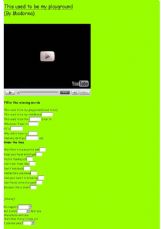
And now, fill the gaps on  the song by Madonna.  Link on the picture


x_3c51743b

viernes, 29 de enero de 2016

BE THE CHANGE, BE PEACEFUL

January 30th is Peace and Non Violence Day, when the death of the national and spiritual leader of India Mahatma Ganghi is commemorated throughout the world.
Find out more about the Indian leader, whose profound spirituality and belief in justice inspired the world.


PLAY THE QUIZ

LinkWithin

Related Posts Plugin for WordPress, Blogger...